Acid reflux after gastric sleeve or bypass affects up to 1 in 3 patients. Dr. Alejandro López explains why it happens — and the surgical solutions that provide lasting GERD relief.
Reflux after bariatric surgery is not simply heartburn — it is a clinical condition where stomach acid flows back into the esophagus, potentially causing damage over time. Recognizing the difference between occasional discomfort and persistent GERD is the first step toward finding the right solution.
Each surgery affects the upper digestive tract differently. The gastric sleeve creates a high-pressure tube that can push acid upward, while the gastric bypass diverts acid away from the esophagus entirely. Understanding your specific anatomy is what determines the right surgical path forward.
Most patients with persistent reflux after bariatric surgery benefit from a thorough evaluation including upper endoscopy, esophageal manometry, and imaging — followed by a personalized recommendation from Dr. Alejandro López.
Watch a quick clinical explanation from Dr. Alejandro López.
By removing 70–80% of the stomach, the gastric sleeve creates a high-pressure tube that can push acid upward into the esophagus.
The Roux-en-Y bypass diverts acid away from the esophagus entirely — making it the gold standard for patients with both obesity and reflux.
Three surgical solutions, evaluated case by case to match your anatomy, symptoms, and goals.
For sleeve patients with mild reflux caused by an undetected hiatal hernia, a focused hernia repair often resolves symptoms without converting the surgery.
Learn About Hernia Repair → 🔄For sleeve patients with persistent reflux unresponsive to medication, conversion to Roux-en-Y gastric bypass is the most reliable long-term solution.
See the Procedure → 💊For patients with both obesity and chronic GERD, Roux-en-Y bypass is the gold-standard surgical solution — addressing both conditions in a single operation.
Why Bypass Is Gold Standard → ⭐If you already had a fundoplication (Nissen) and are now suffering from obesity-related reflux relapse, we can undo the fundoplication and perform a bypass in a single operation.
See Nissen-to-Bypass → 🔍Reflux after gastric bypass is uncommon (5–10% of patients) but real. Understand the most common causes and the targeted treatment options for each.
Causes & Treatment →Patients who underwent a Nissen fundoplication years ago often present a difficult clinical picture: they have regained significant weight, the fundoplication has loosened or migrated, and reflux has returned — sometimes worse than before.
Dr. Alejandro López performs a specialized single-stage operation that undoes the prior fundoplication and converts the anatomy to a Roux-en-Y gastric bypass. Because the bypass anatomy itself diverts acid away from the esophagus, it solves the reflux without needing the fundoplication — while also treating the obesity that caused the relapse.
This is one of the most technically demanding bariatric revision procedures. Dr. Alejandro López's combined training in antireflux, hiatal hernia, and bariatric surgery makes ALO Bariatrics one of the few centers in Mexico that can perform this safely.
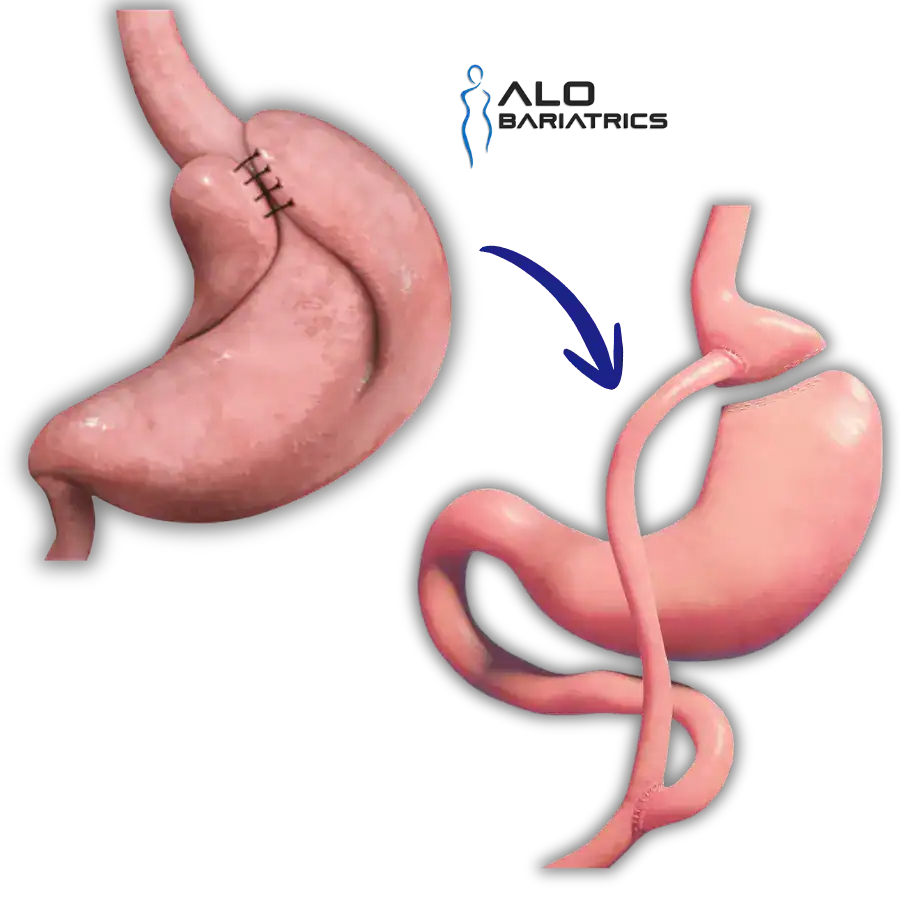
Converting a gastric sleeve into a Roux-en-Y gastric bypass changes both the anatomy and the physiology of the upper digestive tract. The small post-conversion gastric pouch produces very little acid, and the digestive flow is rerouted so that acid no longer travels upward toward the esophagus. For most sleeve patients with persistent reflux, this is the most reliable long-term solution.

DEEPER DIVE · EXTRA READING
Three additional educational guides covering specific reflux scenarios and revision options in depth.
The anatomical reasons sleeve gastrectomy triggers reflux in up to 1 in 3 patients — and what predicts who's at risk.
Read article → SLEEVE-SPECIFICStep-by-step treatment escalation for sleeve patients — from medication and lifestyle changes through surgical revision.
Read article → COMPARISONSide-by-side comparison of all sleeve revision options — bypass, SADI, duodenal switch, re-sleeve — to help you choose.
Read article →Dr. Alejandro López and our medical team review each case individually — including your medical history, current symptoms, prior surgeries, and imaging — to recommend the safest and most effective solution.
Start My Free EvaluationNo cost · No obligation · Confidential review by board-certified surgeons
Board-certified bariatric surgery in Mexico — packages from $4,500
"*" indicates required fields
WhatsApp us