

The Perfect Post-Weight Loss Surgery Diet
Key Takeaways
- Your surgeon will guide you through the first 4 weeks with a strict clinical protocol. The real work — and the focus of this article — is the diet you’ll follow for the rest of your life.
- Two things determine long-term success: 5 daily eating principles and lifelong supplementation. Skipping either is the most common reason patients regain weight.
- The 80/20 rule (perfect 80% of the time, flexible 20%) is what makes the lifestyle sustainable for 5, 10, 20 years.
Most articles about the post-bariatric-surgery diet focus on the first 4 weeks — clear liquids, soft foods, slow reintroduction. That phase matters, but it’s only the beginning. If you Google “what to eat after weight-loss surgery,” you’ll find a hundred articles repeating the same week-by-week timeline.
This article is about something different: what your diet looks like for the rest of your life — the eating principles, the supplements, and the mindset that determine whether your surgery results last 2 years or 20.
Before you read further, it helps to know how this fits into your full patient journey: the 2-week pre-op diet prepares your liver and body for surgery, the post-op clinical diet walks you through weeks 1–4, and post-surgical instructions cover wound care, activity, and warning signs. This article picks up where those leave off — month 2 onward, for the rest of your life.
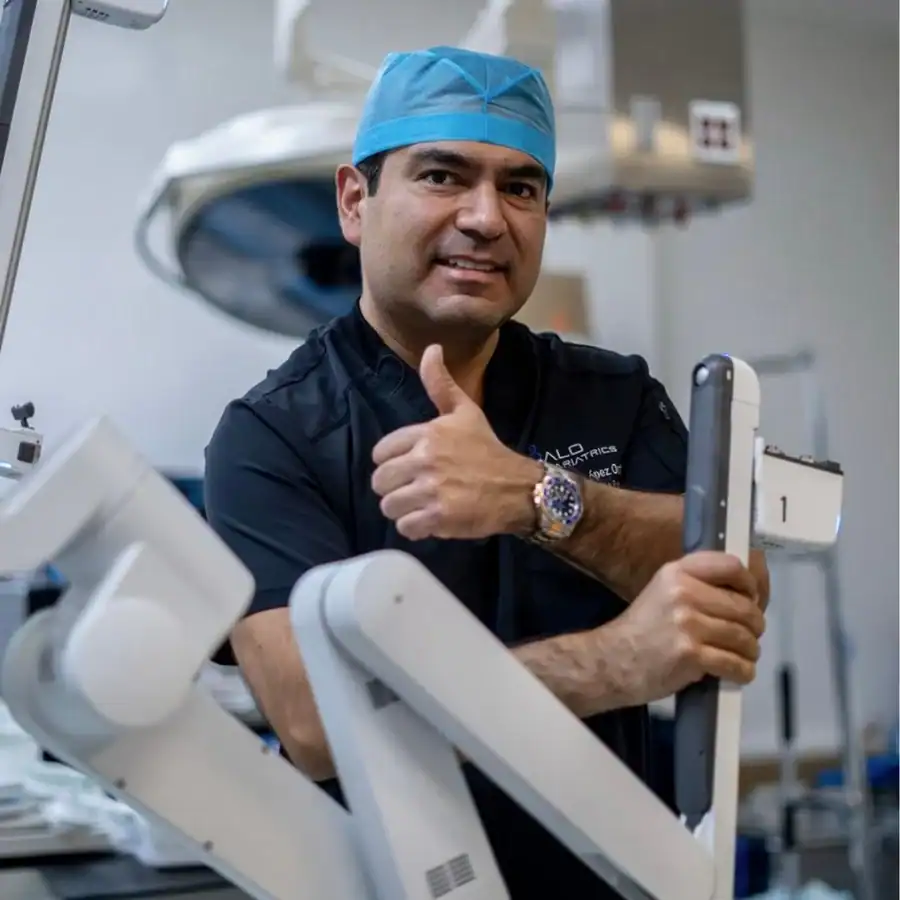
Bariatric surgery is the most powerful weight-loss tool we have. But it’s a tool, not a cure. The patients who succeed long-term treat their diet — and their daily supplements — as a lifestyle, not a temporary protocol. — Dr. Alejandro López Ortega
The First 4 Weeks: A Brief Note on the Clinical Phases
Right after surgery, your nutrition follows a strict 4-phase clinical protocol your surgical team will give you in detail:
- Week 1 — Clear liquids: water, broth, sugar-free electrolyte drinks, clear protein.
- Week 2 — Full liquids: protein shakes, low-fat dairy, blended soups.
- Week 3 — Pureed / soft foods: eggs, Greek yogurt, pureed protein, soft cooked vegetables.
- Week 4+ — Gradual return to regular foods: protein-first, small portions, no sugar/carbonation.
That’s the protocol in 4 lines. It’s strict, non-negotiable, and your team will walk you through it day by day. For the complete clinical breakdown (rules per phase, allowed foods, foods to avoid, downloadable PDF) see our dedicated post-op diet guide.
Once you finish week 4 and your team clears you for regular foods, the real long-term game begins — and that’s where most patients underestimate the importance of structure.
The 5 Principles of Your Long-Term Diet
Every long-term success story we’ve seen at ALO Bariatrics follows these five principles. Not as rules to follow for a year — as the operating system of how you’ll eat for the rest of your life.
Protein at every meal, without exception
Aim for 60–90 g per day, every day, forever. Protein preserves muscle (so you lose fat, not muscle), keeps you full longer than carbs or fat, and supports tissue repair. If you remember nothing else, remember this: protein first, always.
Treat hydration as a daily project
1.5–2 liters of water per day, sipped continuously. Dehydration is the #1 cause of post-op ER visits — and it’s 100% preventable. Carry a bottle. Set reminders. Make it boring and automatic.
Slow down. Chew like it’s a meditation
20–30 chews per bite. Meals lasting 20–30 minutes. This isn’t a quirky rule — it’s mechanical. Your new stomach can’t process anything else without nausea, vomiting, or pain. The patients who eat slowly are the patients who never feel uncomfortable after meals — for years.
Eliminate the “empty” calories permanently
Soda, juice, alcohol, fried food, sugary snacks. Not “limit them” — eliminate them as your default. They sabotage results disproportionately because your daily calorie budget is now small. One bad choice today blocks a week’s progress.
Take your supplements. For life. (See next section.)
This is so important it gets its own section below. Bariatric surgery permanently changes how your body absorbs vitamins and minerals — and the deficiencies that develop are silent until they’re severe. Supplementation isn’t optional after weight-loss surgery. Ever.
Supplements You’ll Take for Life
This is the section most patients underestimate — and the one that causes the most preventable damage years after surgery. Here’s the truth:
Bariatric surgery permanently reduces nutrient absorption. With a smaller stomach (sleeve) you absorb fewer total calories and nutrients per meal. With a bypass or duodenal switch, you also bypass parts of the small intestine where vitamins are absorbed. Even the most disciplined eaters cannot meet their micronutrient needs from food alone after WLS.
The good news: a daily supplement routine takes 90 seconds and prevents virtually all of these issues. Here’s the standard ALO protocol — your team will personalize it based on your procedure and lab results.
Daily core stack — every patient, every procedure
Bariatric multivitamin
A bariatric-specific formula (NOT a regular drugstore multivit). Contains higher levels of B-vitamins, iron, and trace minerals tailored for post-WLS absorption.
Brand: Bariatric Advantage, Celebrate, ProCare Health · 1–2 tablets/dayVitamin B12
Critical for nerve function, energy, and red blood cell formation. Sublingual or injection forms bypass absorption issues. Deficiency causes fatigue, neuropathy, memory problems.
500 mcg/day sublingual · or 1,000 mcg/month injectionCalcium citrate
Bone health and prevention of osteoporosis. Use citrate (NOT carbonate — your stomach acid is too low to absorb it). Take spaced apart from iron supplements.
1,200–1,500 mg/day, split into 500 mg dosesVitamin D3
Works with calcium for bone health and supports immune function. Most post-WLS patients need higher doses than the general population.
3,000 IU/day (adjust based on labs)Iron
Especially important for menstruating women. Iron deficiency anemia is the most common deficiency after gastric bypass. Take with vitamin C for better absorption.
45–60 mg/day · separate from calcium by 2 hrsProtein supplement
Whey or plant-based protein powder. Use as needed to hit your daily 60–90 g protein goal — most patients use 1 shake/day for life.
20–30 g protein per shake · examples: Premier Protein, Unjury, IsopureAdditional supplements — bypass & duodenal switch only
If you had gastric bypass or a duodenal switch, you bypass more of the small intestine and need additional micronutrients monitored:
| Supplement | Sleeve | Bypass | Duodenal Switch |
|---|---|---|---|
| Bariatric multivitamin | ✓ | ✓ | ✓ |
| Vitamin B12 | ✓ | ✓ | ✓ |
| Calcium citrate | ✓ | ✓ | ✓ |
| Vitamin D3 | ✓ | ✓ | ↑ Higher dose |
| Iron | ✓ | ✓ | ✓ |
| Vitamin A | — | ✓ | ✓ |
| Vitamin K | — | — | ✓ |
| Vitamin E | — | — | ✓ |
| Zinc | — | ✓ | ✓ |
| Thiamine (B1) | — | ✓ | ✓ |
Your team will personalize the doses. The principle is simple: more rerouted intestine = more supplements required for life. Annual blood work confirms levels are on track — and lets your team adjust if a deficiency appears.
See the full annual blood-work schedule
Knowing what to test and when is just as important as taking the supplements. We have a complete schedule by procedure type.
Year-by-Year: How Your Diet Evolves
The post-WLS diet shifts as your body adapts and your habits become automatic. Here’s what years 1 through 5+ look like for most ALO patients — the part that matters most for long-term success.
Habits become automatic
By month 12, you’ve stabilized. Stomach capacity is around 1 cup. The protein-first habit is locked in. Most patients have lost 60–70% of excess weight. Daily supplements are non-negotiable. The choice you make this year — to keep the principles or quietly let them slip — determines the next 10 years of results.
Maintenance & muscle building
You’ve hit your lowest weight (usually around month 18). The diet shifts from losing to maintaining. Strength training becomes more important. Calorie needs slowly rise. Patients who add resistance training in year 2 see significantly better long-term body composition than those who only do cardio.
Real life — weddings, vacations, holidays
This is where the 80/20 rule (next section) earns its keep. Most patients regain 5–10% of their lowest weight by year 5 — that’s normal and acceptable. Patients who regain more usually find that one of the 5 principles quietly disappeared (often hydration or a missed daily supplement habit).
The new identity, locked in
If you’ve made it five years living the principles + supplements, the data is overwhelmingly in your favor. ALO patients at year 5+ maintain an average of 65–75% excess weight loss. Annual labs continue. Supplements continue. The protein-first habit is now invisible — it’s just how you eat.
5 Pitfalls That Derail Most Patients
We’ve watched thousands of patients over 20+ years. The ones who lose their results almost always fall into one of these traps:
⚠️ Grazing
Eating tiny amounts continuously throughout the day. Why it kills results: your stomach barely empties between bites, so you can technically consume 2,000+ calories of “small snacks” without ever feeling full. Stick to 3 meals + 1–2 small snacks. No grazing.
⚠️ Drinking your calories
Smoothies, juices, alcohol, milky coffees, sweetened protein drinks. Why it kills results: liquid calories don’t trigger satiety the way solid food does. You can drink 500 calories in 2 minutes and still be hungry. Solid protein wins every time.
⚠️ “I had surgery, I’m safe”
The belief that the surgery alone will keep weight off forever, regardless of habits. Why it kills results: a sleeve can stretch. A bypass pouch can stretch. Old habits creeping back will defeat any procedure given enough time.
⚠️ Skipping follow-up labs
Vitamin and mineral deficiencies develop slowly and silently. Why it kills results: by the time symptoms appear (hair loss, fatigue, neuropathy), the deficiency is severe. Annual labs are non-negotiable for life.
⚠️ All-or-nothing thinking
“I had a piece of cake at the wedding — I’ve ruined everything.” Why it kills results: one bad meal doesn’t break the diet. Quitting because of one bad meal does. The 80/20 rule (below) protects you from this trap.
The 80/20 Rule That Makes It Sustainable
Perfectionism kills more diets than french fries. Here’s the framework that works for our long-term patients:
Be perfect 80% of the time, flexible 20%
If you eat ~21 meals per week, that’s ~17 meals on protocol and ~4 meals where you make a non-protocol choice. A pizza slice at your kid’s birthday. A glass of wine at an anniversary. A dessert at Christmas. Plan it, enjoy it, return to baseline immediately.
The math: if you stay perfect 80% of the time for 5 years, the cumulative effect is enormous. If you try to stay perfect 100% of the time, statistically you’ll burn out within 6–9 months — and then quit entirely. The 80/20 rule isn’t permission to slack; it’s the mechanism that protects long-term consistency.
The trick is making the 20% intentional and rare, not accidental and frequent. A planned dessert at a planned event is 20%. A bag of chips at 9 PM because you’re tired is not.
Frequently Asked Questions
Do I really have to take supplements for the rest of my life?
Yes — and this is non-negotiable. Bariatric surgery permanently changes how your body absorbs nutrients. A bariatric-grade multivitamin plus B12, calcium citrate, vitamin D, and iron are required for every patient (sleeve, bypass, DS). Bypass and DS patients also need vitamin A, zinc, and thiamine. Annual blood work confirms you’re on track and lets your team adjust doses if a deficiency appears.
Can I use a regular drugstore multivitamin instead of a bariatric one?
No. Regular multivitamins are formulated for people with normal absorption — the doses are too low for post-WLS needs, and the iron form is often the kind your stomach can no longer absorb well. Bariatric-specific brands (Bariatric Advantage, Celebrate, ProCare Health) deliver higher concentrations of B-vitamins, iron in a more bioavailable form, and trace minerals at clinically appropriate doses.
Will I be able to eat normally again?
Yes — but “normally” means something different now. By year 1, you eat smaller portions of regular foods comfortably. By year 2+, food feels completely normal — just in smaller amounts and with permanent habit changes. Most long-term patients describe it as the most peaceful relationship with food they’ve ever had.
Can I ever drink alcohol again?
After 6 months, in moderation, with caution. Alcohol absorbs faster after bariatric surgery (especially bypass and DS), affects you more strongly, and is empty calories. Many patients choose to drink rarely or not at all because the cost-benefit isn’t worth it. If you do drink, factor it into your 20%.
What if I regain some weight after year 2?
5–10% regain from your lowest weight is normal and expected. Beyond that, audit the 5 principles — usually one or two have slipped (often hydration, protein-first eating, or a missed daily supplement habit). Most regain is reversible without medical intervention by reactivating the principles for 60–90 days.
Is intermittent fasting OK after WLS?
Generally not recommended for the first year — your priority is hitting protein and hydration goals, which is hard with restricted eating windows. After year 1, some patients do well with a 12-hour overnight fast (e.g. 8 PM to 8 AM). Anything longer should be discussed with your nutritionist first — and never skip your supplements during fasted hours.
📚 Your Complete Patient Resource Hub
This article is one piece of a larger guide. Use these resources together — pre-op, immediately post-op, and long-term — for a complete roadmap.



Ready to start your journey?
Talk to an ALO Bariatrics coordinator and find out which procedure is right for you. Free evaluation, no pressure.
Medically reviewed by Dr. Alejandro López Ortega, MD, FACS
Bariatric surgeon board-certified by the Consejo Mexicano de Cirugía General, Fellow of the American College of Surgeons and founder of ALO Bariatrics (2011), with more than 20,000 bariatric surgeries. ALO Bariatrics operates in Tijuana, Guadalajara and Puerto Vallarta, Mexico; all-inclusive packages start at $4,500 USD. Updated: 2026-09-30.