

Transforming Your Body Image After Weight-Loss Surgery
Your body changes faster than your brain does. This is the part of recovery no one prepared you for — the 6–18 month gap between what the mirror shows and how you feel inside it.
Why your reflection feels like a stranger
The clinical name is "phantom fat" — your brain's body schema (the internal map you use to walk through doorways, choose clothes, and read other people's reactions) updates much more slowly than your actual measurements.
You can lose 100 pounds and still see the old you in the mirror. You can drop six dress sizes and still reach for the largest hoodie in the closet. You can be smaller, healthier, and more energetic than you've been in 20 years — and feel more exposed than before, not less.
That gap is one of the most common — and most under-discussed — parts of weight-loss surgery. It's not a sign anything went wrong. It's a sign that your body changed faster than your identity could keep up. Closing that gap is part of recovery.
Body image, month by month
Every patient is different — but a recognizable arc shows up across thousands of ALO follow-ups. Knowing what's coming makes it less alarming when it arrives.
"This isn't even me yet"
30–50 lb in three months. Face changes first, then collarbones, then waist. Thrilling but disorienting — clothes fall off, ring spins, strangers treat you differently.
"Wait, where do I shop?"
Old wardrobe doesn't fit. New one doesn't exist yet. Often two sizes simultaneously — top and bottom. Highest body-image dissatisfaction reported in this window.
The "in-between" body
Loss slows. Stubborn fat pockets visible. Loose skin settles on arms, abdomen, thighs, chest. Body image often worsens here even though you're lighter than ever.
"This is actually me"
Weight stabilizes. Brain catches up. You stop reaching for the wrong-sized cup, stop sucking in to fit through doors, stop being surprised by your own photos.
Loose skin, scars & the "in-between" body

What no one mentioned before surgery
Significant weight loss almost always leaves some loose skin, and the larger your starting weight, the more pronounced it tends to be. How much depends on age, genetics, hydration, sun exposure, and how long you carried the weight.
Common areas patients notice it:
- Upper arms — often the first place noticed.
- Abdomen — most distressing because clothes can't hide it lying down.
- Inner thighs — chafing becomes a quality-of-life issue.
- Breasts & chest — change shape dramatically for both men and women.
- Face & neck — the most visible to others; usually tightens more than the body.
Modern laparoscopic gastric sleeve and bypass leave small (< ½ inch) scars, typically four or five across the upper abdomen. Most fade significantly over 12 months. SILS (single-incision) patients have one scar hidden in the navel.
What actually helps
The patients who feel most at home in their new body within 12 months tend to use these five tools — not all of them, but most.
Monthly photo journal
Same outfit, same room, same light. The brain underestimates change in real time. Photos correct that.
Non-scale measurements
Track waist, hips, the fit of one specific pair of jeans, energy, and sleep. After month 3, scale lies.
A community that gets it
Find someone 6–12 months ahead of you. ALO patients have access to a private patient community.
Strength training
Once cleared (6–8 weeks). Building muscle reshapes the body — and how it feels to live in it.
Therapy when indicated
Body-image work is recovery, not failure. A bariatric-experienced therapist compresses 12 months of struggle into 8 weeks of progress.
When body contouring fits in
About half of bariatric patients eventually consider some form of skin removal or contouring. The decision is personal — but the timing isn't.
| When | What's appropriate | Why |
|---|---|---|
| Months 0–6 | Nothing surgical yet | Body still changing rapidly; results would be moot in 6 months. |
| Months 6–12 | Skincare, posture, strength training | Build the body underneath the skin first. |
| Months 12–18 | Consultations only | Get information, not procedures. |
| Month 18–24+ | Body contouring decisions | Weight stable enough to lock in a result. |
Common procedures bariatric patients consider once weight is stable: tummy tuck, arm lift, thigh lift, breast lift or augmentation, lower-body lift. ALO's sister practice ALO Aesthetic handles these specifically for post-bariatric patients. Or read our overview of cosmetic surgery after weight loss.
Contouring is cosmetic, not corrective. It will not fix body-image distress on its own — but it works wonderfully after the body-image work is already underway.
Red flags that need professional support
Body-image distress is normal. There's a point, though, where it stops being part of the journey and starts being something a clinician should help with.
⚠️ Please reach out to your team if…
- You're weighing yourself more than once a day, or measuring obsessively.
- You're skipping meals, restricting beyond your protocol, or vomiting on purpose.
- You're avoiding social events because of how you look — for weeks at a time.
- You feel worse about your body now than you did before surgery.
- You're using alcohol, food, or other substances to manage how your body makes you feel.
- You're having thoughts of self-harm.
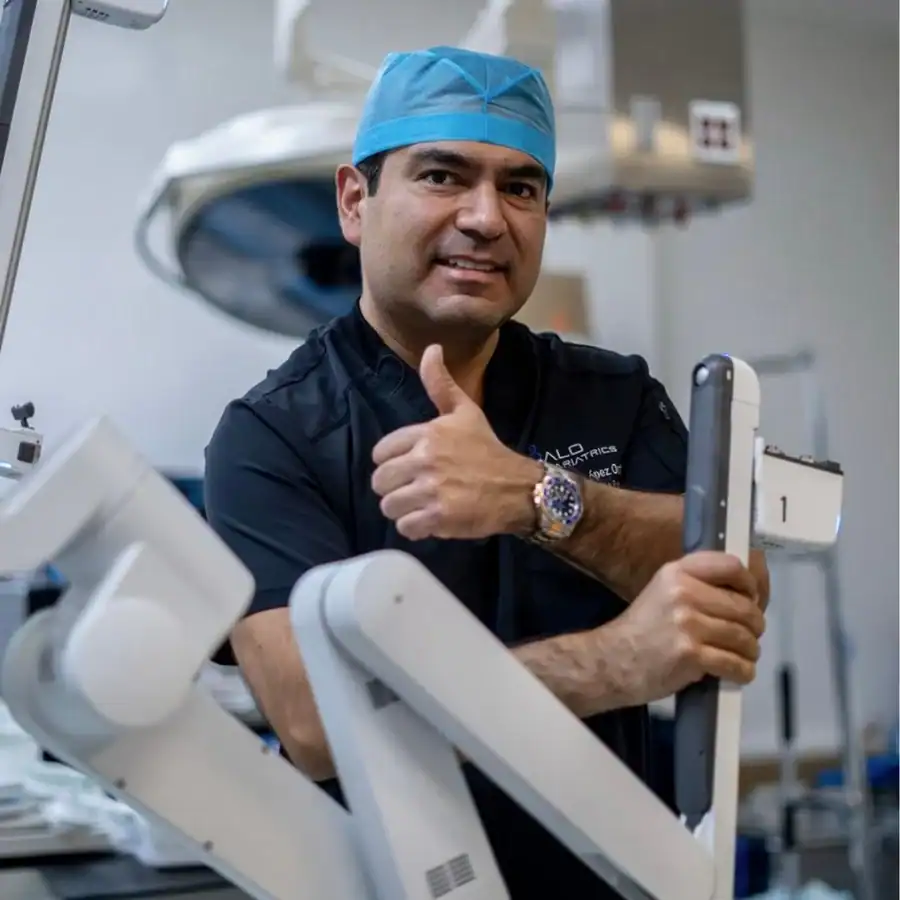
Reviewed by Dr. Alejandro López Ortega, M.D., FACS
"The hardest part of bariatric surgery isn't the operation. It's the months when your body has changed but your identity hasn't caught up yet. Patients who do well long-term treat that gap as something to work through — not a sign that something went wrong."
Frequently asked questions
How long does it take to "feel like myself" again after bariatric surgery?
Most patients describe a real shift around month 12–18 — when weight stabilizes and the brain's body schema finally catches up. Photo journaling and a support community speed this up. If you're past month 18 and still feel disconnected from your body, talk to your nutritionist about a therapy referral.
Is loose skin guaranteed after gastric sleeve or bypass?
Almost always to some degree, especially when losing more than 80 lb. Amount depends on age, genetics, hydration, sun exposure, and how long you carried the weight. Strength training and skincare help, but only surgical skin removal eliminates significant excess skin. See cosmetic surgery options →
Why do I feel worse about my body now than before surgery?
Three reasons: (1) you see your body more clearly now (mirrors, photos, attention), (2) the in-between body of months 6–12 can feel awkward, and (3) social attention can feel exposing rather than affirming. It usually passes once weight stabilizes — but if it lasts beyond 12–18 months, please reach out to your team.
When should I consider body contouring surgery?
Wait until weight has been stable for at least 6 months — usually month 18–24 post-op. Schedule consultations earlier for information, but don't make decisions during the rapid-loss phase. Pursue contouring because you're ready for a refined result, not because you hope it will fix how you feel about yourself.
How do I deal with people commenting on my weight loss?
You don't owe anyone an explanation. Useful short responses: "I've been working on my health, thank you," or simply "Thanks for noticing." If asked how, you decide whether and what to share. Many ALO patients are open about having had surgery; many aren't. Both are valid.
Is it normal that my partner is struggling with my weight loss?
It happens often enough that we discuss it during pre-op counseling. Major change to one person changes the relationship. If your partner is struggling, that doesn't mean the relationship is in trouble — it means a conversation needs to happen. Couples counseling specifically around bariatric change is more common than people realize.
Related ALO resources
Cosmetic Surgery After Weight Loss
Skin removal, contouring, tummy tuck, arm lift — for post-bariatric patients.
Long-Term Diet & Lifestyle
The 5 principles for the rest of your life — protein, hydration, supplements, habits.
Real Patient Stories
Before-and-after journeys from ALO Bariatrics patients.
11 Years of Transformations
Our patient community history — over 20,000 lives changed.
Post-Surgical Recovery
Wound care, activity restrictions, warning signs in the first weeks.
Blood-Work Schedule
Annual labs to monitor your nutrition for life after WLS.
Considering bariatric surgery in Mexico?
ALO Bariatrics has performed over 20,000 procedures with structured nutrition and emotional follow-up included for 12 months. Free virtual consultation, no obligation.