
COMPARISON · 8-MIN READ · UPDATED SEP 2026
Gastric Bypass vs Gastric Sleeve: What's the Difference and Which Is Right for You?
Both produce dramatic weight loss. Both reverse diabetes. But they work differently — and one is clearly better for certain patients. Here is the honest side-by-side comparison.
By Dr. Alejandro López, MD · Bariatric Surgeon · Tijuana · Guadalajara · Puerto Vallarta
The Short Version
- Sleeve: simpler surgery, faster recovery, 60–70% excess weight loss, lower complication rate.
- Bypass: more complex, 70–80% excess weight loss, better for diabetes and reflux.
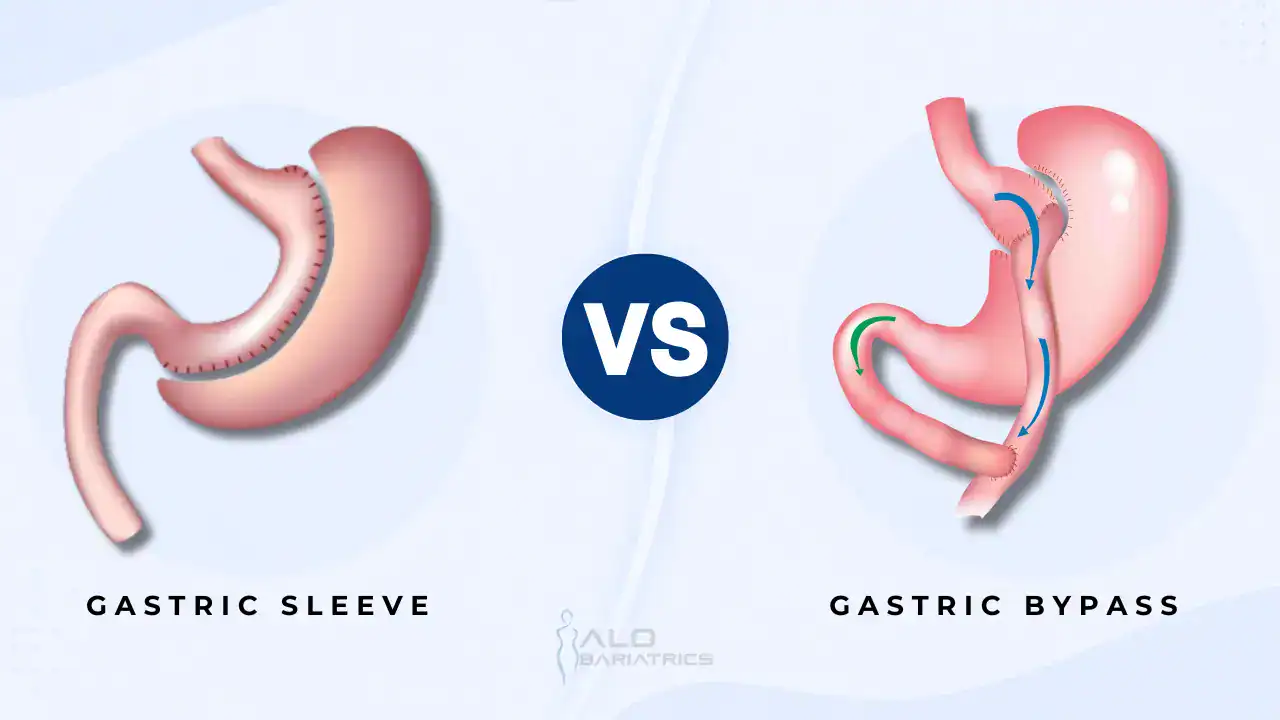
- Sleeve: removes 80% of stomach but does NOT alter intestines.
- Bypass: creates small pouch + reroutes intestine — restrictive AND malabsorptive.
- The right choice depends on YOUR BMI, diabetes status, GERD, and goals.
Gastric bypass and gastric sleeve are the two most common bariatric procedures in the world — accounting for over 90% of all bariatric surgeries. Both work, both have decades of data, both transform lives. But they are different procedures with different trade-offs.
This guide compares gastric bypass with gastric sleeve (manga gástrica) head-to-head — when each is the better choice, the trade-offs of each, and how to decide.
At ALO Bariatrics (Tijuana, Guadalajara and Puerto Vallarta, Mexico), Dr. Alejandro López, MD, FACS performs both procedures: the gastric sleeve from $4,500 USD and the gastric bypass from $5,900 USD, all-inclusive. The table below compares them side by side.
| Gastric sleeve | Gastric bypass | |
|---|---|---|
| How it works | Removes about 80% of the stomach; intestines are not touched (restrictive) | Small 30 ml pouch plus rerouted intestine (restrictive and malabsorptive) |
| Excess weight loss at 1 year | 60 to 70% | 70 to 80% |
| Type 2 diabetes remission | 40 to 60% | 60 to 80% |
| Acid reflux (GERD) | Can cause or worsen reflux in 10 to 30% of patients | Resolves pre-existing reflux in more than 80% |
| Major complication rate | 2 to 3% | 3 to 5% |
| Hospital stay and recovery | 1 to 2 nights; full activity in about 6 weeks | 1 to 2 nights; full activity in about 6 weeks |
| Food restrictions | Fewer | Avoid sugar-heavy foods (dumping syndrome) |
| Vitamins | Lifelong supplementation | Lifelong supplementation, with extra attention to B12 and iron |
| Reversible | No; the removed stomach is gone | Technically possible, rarely performed |
| Long-term data | 20+ years | 50+ years |
| Typical candidate | BMI 30 to 50 without severe reflux or diabetes | BMI 30 to 50 with type 2 diabetes or severe reflux |
| Price at ALO Bariatrics (Tijuana, all-inclusive) | From $4,500 USD | From $5,900 USD |
Figures are the ranges used throughout this article; your surgeon confirms what applies to your case. Prices in Guadalajara and Puerto Vallarta start $500 to $700 higher. See the full price table.
Not sure which one fits you?
Answer a 2-minute questionnaire. Dr. Alejandro López and his team review your BMI, diabetes and reflux history and tell you whether the sleeve or the bypass is the better fit, with no obligation.
See if I qualify →How They Differ Anatomically
Gastric sleeve removes 80% of the stomach, creating a banana-shaped sleeve. The intestines are not touched. The result: smaller stomach holds less food, hormonal changes from removing the fundus reduce hunger. Purely restrictive procedure.
Gastric bypass creates a small stomach pouch (30 ml) and reroutes food past the upper intestine, reconnecting further down. Restrictive (small pouch) AND malabsorptive (skipped intestine). The rerouting creates strong hormonal changes that explain the superior diabetes reversal rates.
6 Differences Between Bypass and Sleeve
DIFFERENCE 1 OF 6
Weight loss — bypass wins by 10%
Bypass: 70–80% excess weight loss at 1 year, sustained at 5 years. Sleeve: 60–70%. For a patient with 50 kg excess weight, that is 5 kg difference. Marginal for most patients; significant for some.
DIFFERENCE 2 OF 6
Diabetes — bypass is the clear winner
Bypass produces complete remission of type 2 diabetes in 60–80% of patients. Sleeve: 40–60%. The hormonal changes from rerouting food are more powerful than from sleeve alone. For diabetes severe with multiple medications, bypass is the better tool.
DIFFERENCE 3 OF 6
GERD/Reflux — bypass cures, sleeve can cause it
Bypass resolves pre-existing GERD in 80%+ of patients. Sleeve CAN CAUSE OR WORSEN GERD in 10–30% of patients. If you have significant pre-op reflux or hiatal hernia, bypass is the safer choice. Sleeve is for patients without significant reflux.
DIFFERENCE 4 OF 6
Complication rate — sleeve has the edge
Sleeve major complication rate: 2–3%. Bypass: 3–5%. Slightly higher with bypass because of intestinal anastomoses. Both are very safe in experienced hands.
DIFFERENCE 5 OF 6
Recovery and lifestyle — sleeve is simpler
Both: 1–2 nights hospital, 6 weeks to full activity. Sleeve patients have less restriction on what foods to avoid. Bypass patients need to avoid sugar-heavy foods due to dumping syndrome risk. Sleeve patients usually report easier “lifestyle” recovery.
DIFFERENCE 6 OF 6
Reversibility — neither truly reversible
Sleeve removes stomach permanently — cannot be undone (the removed 80% is gone). Bypass technically CAN be reversed but it is complex revisional surgery rarely performed. Treat both as permanent decisions.
📌 Bypass vs Sleeve — The Decision Framework
For most patients without severe GERD or diabetes, sleeve is the simpler and safer first choice. For patients with severe diabetes (especially long-standing) or significant reflux, bypass is the better tool. Neither is universally “better” — both are excellent procedures for the right patient. The decision should be made with an experienced cirujano bariatra who evaluates YOUR specific case.
When to Choose Each
Choose sleeve when: BMI 30–50, no severe GERD, no diabetes or mild diabetes, want simpler surgery and easier recovery.
Choose bypass when: BMI 30–50 with type 2 diabetes (especially long-standing), severe GERD or hiatal hernia, want best diabetes reversal data.
Consider switch duodenal when: BMI 50+ or severe long-standing diabetes — sleeve or bypass may be insufficient.
Common Mistakes Choosing Between Sleeve and Bypass
Choosing sleeve because “it is simpler” when you have severe diabetes. Bypass is the more effective tool for diabetes. Skipping it to save 30 minutes of operating time costs you 20% lower remission rate.
Choosing bypass for severe GERD without trying conservative measures first. If reflux is mild, sleeve + PPI may work. Bypass is reserved for moderate-severe cases.
Choosing the procedure your friend had. Your friend’s case is not yours. BMI, comorbidities, age, surgical history all matter.
Picking based on cost difference. $1,000 difference between sleeve and bypass is negligible compared to 10 years of life impact.
Not considering long-term outcome data. Bypass has 50+ years of data; sleeve has 20+. Both are robust but bypass has longer track record.
Letting fear of intestinal rerouting drive sleeve decision. Bypass reroutes the intestine but the connection works the same as your normal anatomy. Not a “more dangerous” procedure.
Sleeve or bypass for YOUR case?
Free 15-min consultation. We evaluate your BMI, diabetes status, GERD history, and goals — and recommend the procedure that fits YOUR case best. No bias toward one or the other.
Frequently Asked Questions
What is the difference between gastric sleeve and gastric bypass?
The gastric sleeve removes about 80% of the stomach and leaves the intestines untouched, so it works by restriction. The gastric bypass creates a small 30 ml pouch and reroutes the intestine, so it is both restrictive and malabsorptive, with stronger hormonal effects on diabetes and reflux.
Which is better, gastric sleeve or gastric bypass?
Neither is universally better. For most patients without severe reflux or diabetes, the sleeve is the simpler and safer first choice. For patients with type 2 diabetes, especially long-standing, or with significant reflux, the bypass is the better tool. An experienced bariatric surgeon decides with you based on your BMI, diabetes status, reflux history and goals.
Which loses more weight: bypass or sleeve?
Bypass produces 70 to 80% excess weight loss at one year; sleeve 60 to 70%. For a patient with 50 kg of excess weight, that is about 5 kg of difference. Marginal for most patients, significant for some.
Which is better for type 2 diabetes?
Bypass. It produces complete remission of type 2 diabetes in 60 to 80% of patients, versus 40 to 60% with the sleeve. For patients on several diabetes medications, bypass is the more effective tool.
Which is safer, and which is more dangerous?
The sleeve has a slightly lower major complication rate, 2 to 3% versus 3 to 5% for bypass, because it does not involve intestinal connections. Both are very safe in experienced hands; the difference is small.
What are the side effects of each procedure?
Sleeve: it can cause or worsen acid reflux in 10 to 30% of patients. Bypass: dumping syndrome after sugar-heavy foods and a higher need for B12 and iron supplements. Both require lifelong vitamins and a permanent change in how you eat.
Which is better if I already have acid reflux (GERD)?
Bypass. It resolves pre-existing reflux in more than 80% of patients, while the sleeve can make reflux worse. If you have significant reflux or a hiatal hernia, bypass is the safer choice.
Can a gastric sleeve be converted to a bypass later?
Yes. Sleeve-to-bypass conversion is a well-established revision surgery, usually performed for persistent reflux or inadequate weight loss. It adds complexity but is feasible.
Which has better long-term results?
Bypass has more than 50 years of outcome data; the sleeve has more than 20. Both have proven track records. The sleeve has become the most common bariatric procedure worldwide.
How much do gastric sleeve and gastric bypass cost in Mexico?
At ALO Bariatrics the gastric sleeve starts at $4,500 USD and the gastric bypass at $5,900 USD in Tijuana, all-inclusive: surgeon, hospital, anesthesia, recovery hotel and ground transportation. Guadalajara and Puerto Vallarta start $500 to $700 higher.
Sleeve vs bypass vs duodenal switch: when is the switch the better option?
When BMI is 50 or higher, or diabetes is severe and long-standing, a sleeve or bypass may be insufficient and a duodenal switch or SADI-S is considered. At ALO Bariatrics SADI-S starts at $6,900 USD and the duodenal switch at $7,200 USD in Tijuana.
Will I need vitamins for life with both?
Yes. Lifelong supplementation is required after both procedures. Sleeve patients have slightly less malabsorption because only the stomach is altered; bypass patients need closer attention to B12 and iron.
One last thing
The “best” between sleeve and bypass depends entirely on YOUR case — your BMI, your diabetes status, your reflux history, your goals. An honest cirujano bariatra evaluates these factors and recommends the right procedure for YOU. If your surgeon has a strong default preference for one over the other in all cases, get a second opinion. The right choice should be specific to your medical case.
Medically reviewed by Dr. Alejandro López Ortega, MD, FACS
Bariatric surgeon board-certified by the Consejo Mexicano de Cirugía General, Fellow of the American College of Surgeons and founder of ALO Bariatrics (2011), with more than 20,000 bariatric surgeries. ALO Bariatrics operates in Tijuana, Guadalajara and Puerto Vallarta, Mexico; all-inclusive packages start at $4,500 USD. Updated: 2026-09-20.