
CANADA · 7-MIN READ · UPDATED APR 2026
Obesity in Canada: The 2026 Reality and What Patients Can Do
1 in 3 Canadian adults has obesity. Healthcare wait lists for bariatric surgery stretch 3–5 years. The intersection of these two facts has changed how Canadians access bariatric care.
By Dr. Alejandro López, MD · Bariatric Surgeon · Tijuana · Guadalajara · Puerto Vallarta
The Short Version
- ~30% of Canadian adults have obesity (BMI ≥ 30); 10% have severe obesity (BMI ≥ 35).
- Provincial wait lists for bariatric surgery: 2–5 years average.
- Type 2 diabetes affects ~10% of Canadian adults — most cases linked to obesity.
- Direct healthcare costs of obesity in Canada: $5–7 billion CAD annually.
- Canadians increasingly choose Mexico for faster, lower-cost bariatric care.
Obesity in Canada has reached levels that strain both individual health and the public healthcare system. 1 in 3 Canadian adults has obesity. Healthcare wait lists for bariatric surgery — the most effective treatment — stretch 3–5 years across most provinces. The result: many Canadians who medically need surgery wait years for treatment, accumulating preventable comorbidities.
This guide explains the obesity landscape in Canada, the healthcare system’s response, and how Canadians are finding alternative paths to bariatric surgery — including bariatric surgery in Mexico for shorter timelines and lower costs.
The Numbers Behind Canadian Obesity
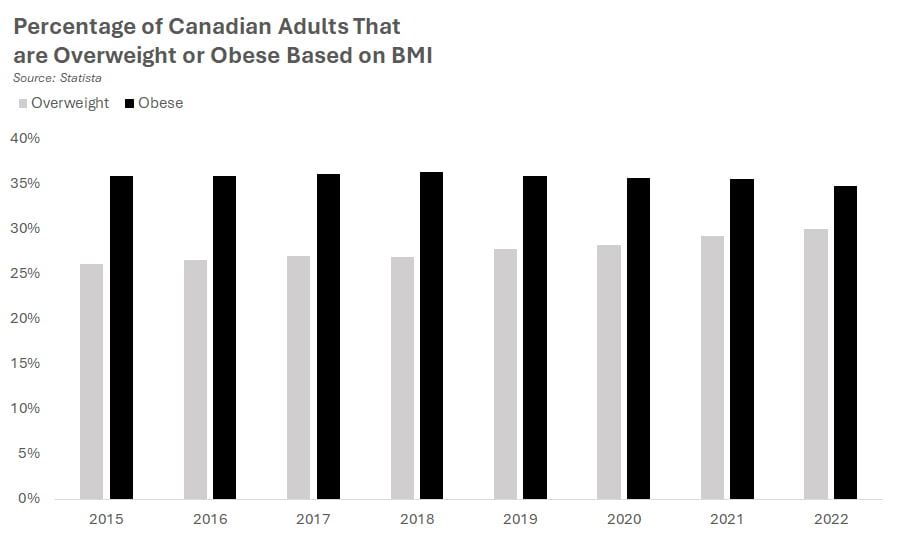
Statistics Canada data shows ~30% of Canadian adults have obesity (BMI ≥ 30), with 10% at severe obesity (BMI ≥ 35). Provincial variation: highest rates in Newfoundland, New Brunswick, Saskatchewan; lowest in BC and Quebec. Childhood and adolescent obesity has tripled over 30 years.
Related conditions: type 2 diabetes affects ~10% of adults, sleep apnea ~5%, hypertension ~25%. Direct healthcare costs of obesity-related conditions: $5–7 billion CAD annually. Indirect costs (lost productivity, disability): another $5–8 billion CAD.
6 Facts About Obesity in Canada
FACT 1 OF 6
Obesity rate: 1 in 3 Canadian adults
Statistics Canada 2023 data shows 29.7% of Canadian adults have obesity. Severe obesity (BMI ≥ 35) affects ~10%. The trend has been steadily upward for 40 years despite numerous public health interventions.
FACT 2 OF 6
Provincial healthcare struggle to keep pace
Bariatric surgery is technically covered by provincial health plans, but capacity is far below demand. Wait lists in Ontario, Alberta, Saskatchewan: 3–5 years. BC, Quebec slightly shorter (2–3 years). Atlantic provinces variable.
FACT 3 OF 6
Type 2 diabetes is the most common comorbidity
Approximately 10% of Canadian adults have type 2 diabetes — and the vast majority of cases are linked to overweight or obesity. Diabetes Canada data shows direct medical costs of diabetes in Canada: $30 billion CAD annually.
FACT 4 OF 6
GLP-1 medications (Ozempic, Mounjaro) shift dynamics
The introduction of GLP-1 medications has provided a new tool for moderate obesity (BMI 30–35) and obesity with type 2 diabetes. Provincial coverage varies. Costs without coverage: $300–$500 CAD/month. Pérdida 15–20% del peso while taking them.
FACT 5 OF 6
Surgery remains the most effective for severe obesity
For BMI ≥ 35 with comorbidities or BMI ≥ 40, bariatric surgery remains the gold standard. 70–80% excess weight loss, sustained 5–10+ years. Reverses type 2 diabetes in 60–80% of cases. No other intervention matches this.
FACT 6 OF 6
Mexico is the most common alternative for Canadians
The 3–5 year provincial wait list has driven a generation of Canadians to seek surgery abroad. Mexico is the most common destination — proximity, accreditation, surgeon volume, all-inclusive packages at $6,000–$10,000 CAD. Demand has grown 25%+ annually since 2020.
📌 The Canadian Obesity Reality
Canada has world-class healthcare in many areas — but for bariatric surgery, the wait list reality leaves many patients accumulating preventable damage while they wait. Choosing self-pay options (private Canadian or Mexico) is not failure of the public system — it is sometimes the rational health decision for an individual patient. Each patient must weigh the cost of waiting against the cost of action.
What Canadian Patients Can Do
Step 1: Talk to your family doctor. Get on the provincial bariatric wait list ASAP if you qualify (BMI ≥ 35 + comorbidity, or BMI ≥ 40).
Step 2: Explore GLP-1 medications for moderate cases. Effective for BMI 30–35 without severe comorbidities.
Step 3: If you have severe obesity (BMI 35+) with worsening comorbidities, evaluate self-pay options. Private Ontario clinics: $20,000–$30,000 CAD, 4–8 months. Mexico: $6,000–$10,000 CAD, 2–4 weeks.
Step 4: Get travel insurance with bariatric-specific coverage if going to Mexico. Plan Canadian PCP follow-up for the next 30 years.
Step 5: Make the decision based on YOUR health, not the system’s constraints. Waiting 4 years for OHIP when diabetes is progressing is sometimes the wrong choice for your body.
Mistakes Canadians Make About Obesity
Believing willpower alone fixes severe obesity. The biology fights against it. 95% of severe obesity patients regain weight with diet alone within 5 years.
Waiting passively on provincial wait lists. While waiting, comorbidities accumulate. Engage proactively — get on pre-op programs early, prepare for surgery.
Assuming Mexico is unsafe. At accredited centres, safety matches Canadian private clinics. Verify accreditation, surgeon credentials, complication rates.
Not getting travel insurance. Mandatory for medical tourism. $200–$500 CAD for the trip.
Skipping Canadian PCP coordination after Mexico surgery. Your Mexican surgeon does the operation; your Canadian doctor manages the next 30 years.
Treating obesity as a moral failure. It is a medical condition. Effective treatments exist. Get the treatment that works for YOUR case.
Canadian patient considering bariatric?
We have helped 1,000+ Canadian patients. Free 15-min video consultation — evaluate your case, explain Mexico options, compare with provincial wait lists. No pressure, just honest medical input.
Frequently Asked Questions
How common is obesity in Canada?
About 30% of Canadian adults have obesity (BMI ≥ 30). 10% have severe obesity (BMI ≥ 35). Rate has been rising for 40 years despite public health interventions.
Does provincial healthcare cover bariatric surgery in Canada?
Yes — most provincial plans cover gastric sleeve and bypass. Eligibility: BMI ≥ 35 + comorbidity or BMI ≥ 40. Wait lists: 2–5 years average.
How long do Canadians wait for bariatric surgery?
Provincial wait lists: Ontario 3–5 years, Alberta 3–4 years, BC 2–3 years, Quebec 2–4 years, Atlantic variable. Private clinics: 4–8 months. Mexico: 2–4 weeks.
Is bariatric surgery in Mexico safe for Canadians?
At accredited centres with experienced surgeons, yes — safety matches Canadian private clinics. Full safety guide for Canadians.
How much does bariatric surgery in Mexico cost for Canadians?
$6,000–$10,000 CAD all-inclusive (vs $20,000–$30,000 private Ontario). Includes surgeon, hospital, anesthesia, recovery hotel, ground transport. Flights from Canada extra ($400–$900 CAD).
What about Ozempic for Canadian patients?
GLP-1 medications (Ozempic, Wegovy, Mounjaro) are now available in Canada. For moderate obesity (BMI 30–35) and obesity + diabetes, these can be effective alternatives to surgery. Cost: $300–$500 CAD/month without insurance.
Will my Canadian doctor support Mexico surgery?
Most family doctors are pragmatic — they will provide pre-op clearance and post-op follow-up regardless of where surgery occurred. Some bariatric specialists are critical, often based on legitimate concerns about specific clinics. Bring your Mexican centre’s credentials and complications data.
One last thing
Obesity in Canada is a public health crisis the healthcare system has not been able to keep pace with. For individual patients, the choice often comes down to: wait 4 years and accept worsening comorbidities, or take action with self-pay options. There is no wrong answer — only the right answer for YOUR situation. Get the treatment that works for your body, not the one that fits the system’s constraints.
Medically reviewed by Dr. Alejandro López Ortega, MD, FACS
Bariatric surgeon board-certified by the Consejo Mexicano de Cirugía General, Fellow of the American College of Surgeons and founder of ALO Bariatrics (2011), with more than 20,000 bariatric surgeries. ALO Bariatrics operates in Tijuana, Guadalajara and Puerto Vallarta, Mexico; all-inclusive packages start at $4,500 USD. Updated: 2026-07-26.